
India accelerates MLFF rollout with 104 more toll plazas in pipeline
India is accelerating the rollout of multi-lane free-flow (MLFF) tolling across its national highway network, with five barrier-free sites now operational, contracts awarded at 17 toll plazas and bids invited for a further 104.
The National Highways Authority of India (NHAI) is using a combination of RFID-based FASTag electronic toll collection, automatic number plate recognition (ANPR) and AI analytics to allow vehicles to pass through charging points without stopping, slowing down or remaining in a designated lane. According to the latest government figures, published on 22 July, MLFF is live at Choryasi in Gujarat, Mundka in Delhi, Gharaunda in Haryana and Daulatpura and Manoharpura in Rajasthan.
Some 12 further locations have been awarded for conversion, while tenders have been launched covering an additional 104 toll plazas around the country. The programme has expanded rapidly since India opened its first comprehensive MLFF site at Choryasi on the Surat–Bharuch section of NH-48 on 1 May. Around 41,500 vehicles passed the location on its first day of operation.
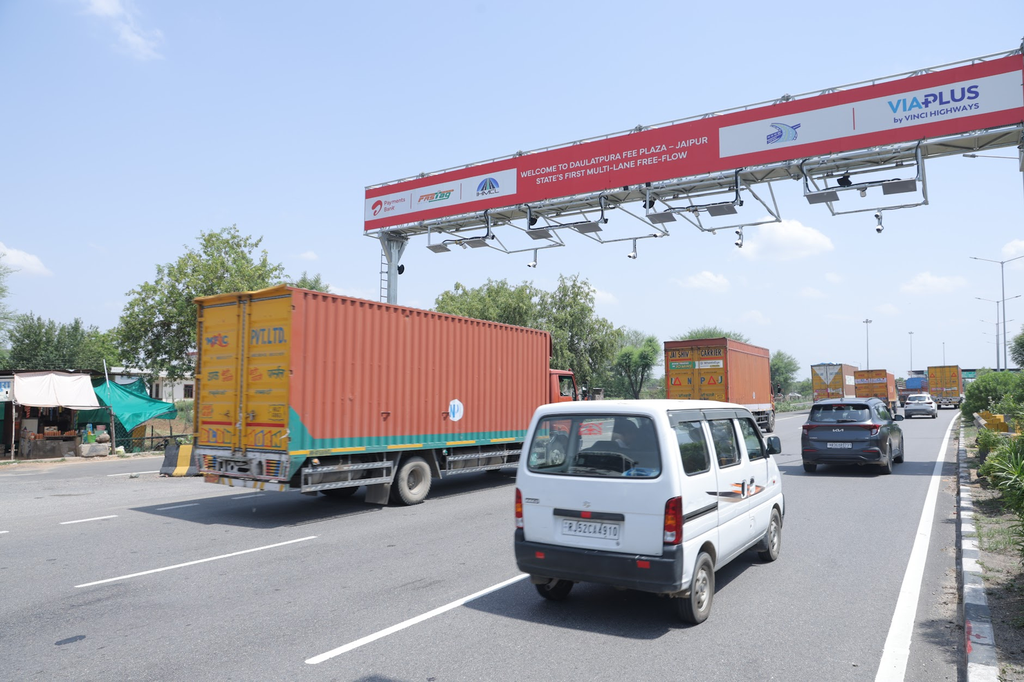
A second system subsequently opened at Mundka on Delhi's Urban Extension Road-II, followed by Daulatpura on the Delhi–Jaipur section of NH-48 on 19 June, Gharaunda on NH-44 on 25 June and Manoharpura on NH-48 on 1 July. The Daulatpura deployment provides an example of the technology being used underneath the national programme.
ViaPlus acted as systems integrator for the project, which was delivered in five months in partnership with Airtel Payments Bank for Indian Highways Management Company Limited (IHMCL). Sidra Systems supplied its Parsec lane controller, while Star Systems International supplied Titan Pro RFID readers and Avior antennas.
The site also incorporates overhead vehicle detection and classification equipment, ViaPlus' Alpha back-office platform and AI-based image review technology. Vehicles can be identified through their FASTag or by ANPR. Star Systems has since highlighted its involvement in India's expanding MLFF programme, saying its RFID technology is intended to provide accurate vehicle detection under high-speed free-flow conditions.
The wider rollout represents a significant shift from India's traditional barrier-based toll plazas. Rather than moving immediately to satellite-based road charging, the government has opted to build on the country's established FASTag system and combine it with ANPR and AI. India's Ministry of Road Transport & Highways said expert committees had recommended further consideration of GPS-based barrier-free tolling because of issues including security, privacy and operational control.
The government has therefore selected FASTag and ANPR/AI as the technology for the current MLFF programme. Enforcement is also being adapted for barrier-free operation.
At Manoharpura, for example, vehicles with insufficient FASTag balances or invalid or non-functioning tags are issued an electronic notice for unpaid tolls. Users have 72 hours to pay the normal toll after receiving the notice. If payment is not made within that period, the charge increases to twice the normal rate for the vehicle category.
The 17 locations already awarded for MLFF implementation extend beyond the five operating sites and include Shahjahanpur in Rajasthan, three toll plazas in Tamil Nadu, three in Andhra Pradesh, two in Maharashtra, Badarpur Faridabad in Haryana, Boraich in Gujarat and Madanpur in Assam.
The government has also invited bids for 104 additional plazas, signalling a move from initial demonstration projects towards a much wider deployment of barrier-free charging across the national highway network. India's tolling system is already overwhelmingly digital. National highway toll payments moved to FASTag and UPI-only collection in April 2026, subject initially to temporary electoral exemptions in several states.
The continued expansion of MLFF is intended to remove the remaining physical toll plaza stop from that process, allowing identification, charging and enforcement to take place while vehicles remain in motion.